Artificial Intelligence (AI) is transforming virtual production. It is changing how films, television shows, and immersive media content are made. By automating labour-intensive tasks, AI makes production smoother and more efficient. It lets creators innovate, reduce costs, and finish projects faster. From pre-visualisation to advanced editing, AI has become a core tool in virtual production.
AI improves efficiency, boosts visual quality, and supports more ambitious storytelling in immersive tech. Today, AI plays a role in almost every aspect of virtual production, becoming a core part of modern immersive experiences. Its role continues to expand, impacting creative workflows in new ways.
Recent reports show that nearly 80% of media executives plan to integrate AI into their production processes. AI is now a significant factor in media companies’ decision-making.
AI in pre-production planning
The pre-production phase includes activities such as storyboarding and environment planning. AI tools are making a significant impact at this stage:
- Storyboarding and Visualisation: Tools like Midjourney, DALL-E, and Stable Diffusion have changed how scenes are visualised. Directors and producers can create detailed images of scenes using text prompts, eliminating the need for hand-drawn storyboards. Teams can then share and refine visual concepts more efficiently.
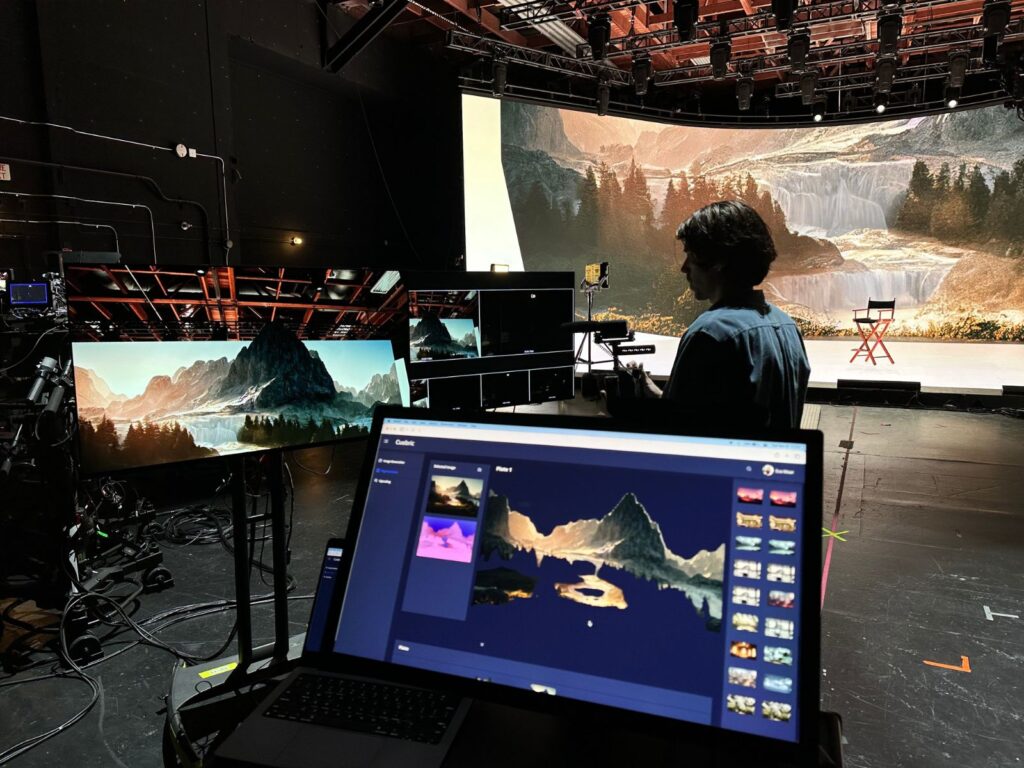
- Real-Time Environment Generation: Cuebric helps creators generate virtual environments in real time. These environments can be integrated into Unreal Engine for pre-visualisation or final production on LED volume stages. This approach reduces repetitive tasks in pre-production and gives teams the flexibility to adapt ideas as needed. The real-time capabilities also support on-the-spot changes, making planning more flexible.
AI on-set with digital actors and Simulcam
AI tools are valuable during production. They provide digital assets and speed up on-set operations for immersive content:
- Simulcam Technology: Weta FX developed Simulcam, which combines live-action footage with digital backgrounds in real time. This technology is now used in virtual production studios for immersive experiences. Camera operators can see how scenes look in fully rendered environments. The system uses Lidar-scanned data to predict and visualise the scene’s geometry, holding precise register between live and virtual elements. This reduces discrepancies and makes the join between live-action and CGI more convincing.
- Digital Actors and Character Creation: AI-based technologies create realistic digital actors. For example, deepfake technology de-ages actors or creates entirely virtual characters. This is particularly helpful in immersive experiences where digital avatars play a major role. These avatars enrich virtual reality (VR) by providing lifelike characters that interact with users in real-time, adding creative flexibility without the high cost of reshoots. This enables production teams to focus on the creative aspects rather than costly technical adjustments.
Post-production editing and audio synthesis with AI
Post-production is where creative finesse shines, and AI offers powerful ways to work with both visual and audio content:
- Voice Cloning and Speech Synthesis: Respeecher recreates iconic voices or generates new ones for digital characters in virtual environments. This technology has been applied in Virtual Reality and Augmented Reality to create personalised experiences. VALL-E can also simulate voices with just a few seconds of sample audio, retaining the emotional quality of the original speaker. This approach works well for story-driven VR, where realistic voiceovers lift engagement. Voice synthesis tools add depth to immersive experiences by making character interactions feel genuine.
- Video Style Transfer and AI-Assisted Editing: Gen-1 by Runway lets editors apply styles from one video to another, keeping visual consistency without manual adjustments. Nuke CopyCat replicates complex effects across sequences, which is especially useful in VR productions that need consistent visual quality to maintain immersion. These AI-assisted tools save time, allowing editors to concentrate on the artistic elements of post-production.
AI for live productions and on-the-fly scene changes
AI’s impact also extends into live productions, where it allows for the real-time manipulation of virtual environments for immersive events:
- Real-Time Scene Adjustment: AI tools like Cuebric allow creators to modify virtual sets during live production in real-time. They can adapt to creative changes as they arise, which is especially useful in mixed reality (MR) performances, where audience interaction may require quick adjustments to maintain a smooth experience.
- Metaphysic’s AI at the VMAs: At the 2024 VMAs, Metaphysic used generative AI to lift live performance with real-time VFX. By blending live action with synthetic elements, they created a striking experience, showcasing AI’s potential for interactive performances. This demonstrated how AI can elevate traditional performances, making them more engaging for audiences.

AI Innovations in Virtual Production Studios
AI is not only improving production results but also transforming how virtual production studios operate. It supports creativity and efficiency:
- LED Volume Stages and Real-Time Feedback: Studios like Vu Studios use AI tools to generate depth segmentation and inpainting for virtual environments on LED volume stages. With tools like Cuebric, teams can refine virtual sets smoothly, allowing rapid transitions between physical and digital environments. Vu Studios also focuses on developing more accessible LED stage technology, making high-quality virtual production available to a broader range of creators. Real-time feedback helps identify and resolve potential issues early, which makes the production workflow more efficient.

- Collaborative AI Systems: AI improves teamwork by automating repetitive tasks, allowing artists and directors to focus on the creative aspects of production. By reducing manual workload, AI supports a more enjoyable creative process, helping prevent burnout and helping teams produce high-quality immersive content. The use of collaborative systems encourages team members to engage in more innovative and strategic thinking.
The enterprise metaverse where AI and virtual production converge
The combination of AI and virtual production is paving the way for the enterprise metaverse. This digital ecosystem allows audiences to engage with immersive environments in new ways:
- Virtual Sets and Interactive Experiences: AI-generated digital twins of film sets create immersive experiences. Imagine exploring a virtual movie set, interacting with props, and encountering digital characters in a metaverse platform. Studios like Disney and Warner Bros. are developing these immersive experiences to engage viewers beyond traditional formats, providing new opportunities for interaction. These virtual sets also make content more accessible, allowing audiences to experience production environments from anywhere.
- Real-Time Data Feeds: The next step for AI in virtual production involves using real-time data from on-set devices, like IoT sensors, to adjust virtual elements during filming. For immersive productions, this means VR experiences that change based on user interactions or environmental factors, making them more adaptive and authentic. Real-time data creates a more responsive and personalised experience for the audience.
The future of AI in virtual production
The evolution of AI within virtual production is still in its early stages, and greater opportunities lie ahead. As technology advances, new applications in filmmaking and immersive content creation will emerge:
- Adaptive Visual Effects (VFX): With further advances in machine learning, visual effects could change based on audience reactions or interactions. Imagine a VR or AR experience where certain sequences adjust in real-time based on user behaviour. This would create a personalised, engaging experience. This adaptability could lead to new forms of audience-driven narratives.
Conclusion
AI is transforming virtual production by creating new opportunities for creativity, efficiency, and audience engagement. AI improves every stage of production, from planning and on-set work to post-production and live events, helping creators achieve results that were previously out of reach. It enables production teams to explore new creative possibilities, making what once seemed impossible achievable.
For studios and teams working in immersive technology, adopting AI is fast becoming standard. Whether it’s about improving efficiency, cutting costs, or opening up new creative possibilities, combining AI with virtual production signals a future of limitless immersive creativity.