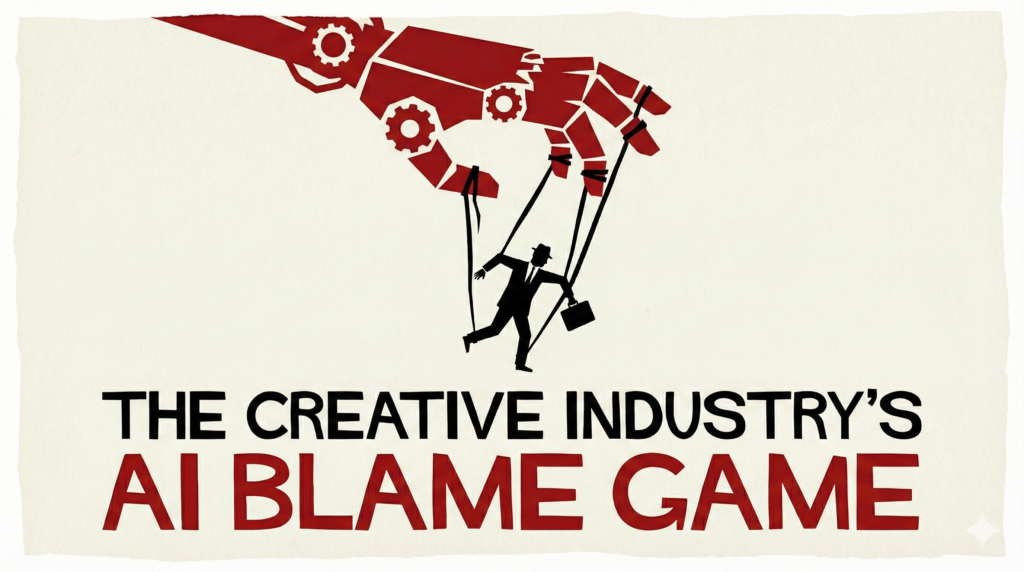
The visible AI hiring market in creative tech is quiet. Few senior roles on the job boards, little public movement, not much noise. Read at face value, it looks like adoption has slowed. The opposite is true. The senior hires that build a real AI capability are being made through confidential retained search, off the public market, and the silence is deliberate.
Three pressures keep these hires off LinkedIn, and all three have sharpened in 2026. The first is what the hire signals to a company’s own staff. The second is what it signals to competitors. The third is what it signals to a public that has turned sharply against AI-made work. Each is a question of timing, not concealment, and a company that gets the timing wrong pays for it in all three directions at once.
An open hire reads as a redundancy plan
The strongest reason for keeping an AI leadership hire quiet sits inside the building. 2026 has tied AI and job cuts together in the public mind in a way that is hard to undo. Tech companies have cut well over 100,000 roles this year, with Amazon removing around 16,000 corporate jobs in a single quarter and Meta cutting 8,000, about a tenth of its workforce, while the same companies commit a combined $700 billion to AI infrastructure (CNBC, 2026). The phrase doing the rounds is an AI-driven labour crisis.
Whether AI is the real cause is a separate and contested argument. The Washington Post has made the case that much of it is ordinary austerity wearing an AI badge. The perception has set regardless. For a creative and media company, announcing a Head of AI or a Director of Machine Learning in that climate reads one way to its own people, as the first move in replacing them. A confidential hire avoids handing every existing employee a reason to start looking. The company brings the capability in, settles how it sits alongside the existing teams, and has an answer ready before the question is asked in the corridor.
The second is competitive
The second reason is the one most often cited, and it holds. Every senior job advert is a statement of intent. A role for a Head of AI-Generated Content tells the market a company is moving into automated production. A Director of Machine Learning for Real-Time Rendering points straight at a virtual production strategy. The title alone maps the direction of travel, and competitors read job adverts as closely as they read the trade press.
For a company still building, that disclosure comes too early. Being first depends on getting the capability in place before rivals know to look for it. A public advert trades that head start for a few weeks of inbound applications, most of them from people the company would never hire. The quiet route keeps the strategy off the board until the work is ready to speak for itself.
Naming AI invites a consumer fight
The third reason has grown fastest. Telling the market that your output involves AI now carries a real consumer cost. Coca-Cola has run AI-made holiday advertising two years running and drawn a backlash both times, with viewers calling the work soulless and pledging to boycott (NBC News, 2025). McDonald’s pulled an AI Christmas ad after a similar reaction (Marketing Dive, 2026). The criticism sharpens when a brand is posting record profits, because replacing creative people with software then reads as a cost cut dressed as innovation.
For an agency or studio, a public AI hire signals to clients and audiences that the work they are buying may be machine-made, and invites exactly that fight. High-profile brands carry the worry most heavily, because the reputation at risk is theirs. When a client learns its agency is building AI capability, the questions come quickly, about brand perception, about IP, about what happens when their own customers find out. Those conversations belong in a private briefing, where they can be answered with proof rather than promises.
Discretion is what the fee buys
Confidential retained search is built for exactly this set of pressures. A company commissions a dedicated search and pays for it upfront, which buys discretion as much as focus. The work runs through direct approaches and established networks rather than open adverts. There is no public listing and no company name until both sides are ready, which removes the risk of a candidate’s current employer, or a company’s own staff, learning about the move before there is anything to explain.
For the company, that opens access to senior people who would never answer an advert. For the candidate, it means a real move without the exposure of a visible job search. The whole conversation stays private until both parties choose otherwise.
The best candidates aren’t looking
The people these companies want are mid-to-senior specialists who know their value, and so do their current employers. They are well paid, embedded, and aware that a visible job search carries risk. They will not reply to an open advert when the wrong person seeing it could cost them at work.
What they respond to is a direct approach about a real role, specific enough to be worth their time, rather than a vague networking request. The senior end of this market moves on trust and precision, through intermediaries who hold the confidence on both sides. In the searches we run, the strongest candidates are almost never the ones already looking.
The quietest companies are often the fastest
The build happens out of sight, but it leaves marks. A company starts winning pitches against companies several times its size. Production timelines shorten with no visible growth in headcount. Output climbs. The same people begin speaking at industry events about AI in practice rather than AI in theory.
Watch for work whose quality shifts suddenly. Productions that took months arriving in weeks. Creative variations that once needed a full team produced by a handful of people. That pattern is rarely luck. It is usually a team hired quietly while competitors were still debating whether to start.
This won’t stay confidential forever
This won’t stay confidential forever. The companies that secured talent first will show results, client resistance will ease as the advantage becomes plain, and what is hidden now will be presented on a conference stage later. The market tips the moment enough recognised brands back AI-assisted work in the open, and the internal and public concerns lose their charge. After that, the secrecy has no purpose and companies compete for AI talent in daylight.
We aren’t there yet. While the transition runs, the confidential route is where the strongest senior hires are made. We run these searches for creative tech companies, so the territory is familiar, whether a company is building capability quietly or a senior candidate is weighing a move in confidence.